After many years of learning about the spiritual meaning of the Jewish holidays according to the wisdom of Kabbalah, we thought it was judicious to bind together selected source excerpts on the topic from the greatest kabbalists throughout the ages, and primarily Rav Yehuda Leib HaLevi Ashlag (Baal HaSulam), and his firstborn son and successor, my teacher, Rav Baruch Shalom HaLevi Ashlag (RABASH).
Landmarks: The development of the soul in the cycle of the year was compiled so as to pave the way for all our friends, Kabbalah students from around the world, who aspire to be Israel—Yashar El [directly to the Creator], namely to aim themselves directly to the upper force, the power of bestowal and love.
In Hebrew, the word Hag [holiday/festival] comes from the word Hug, meaning a circle. As the hands of a clock repeatedly return to the same numbers, we, too, experience spiritual states in a cyclical process. It begins with the exodus from Egypt, which we celebrate on Passover, symbolizing the beginning of the process, and ends with the final correction on the holiday of Purim.
Each holiday and festival in the cycle of the year is like a landmark symbolizing an important stage in the development of the soul. Through these stages, we come to know ourselves, build ourselves, and experience the spiritual process over and over again.
I am thankful to my devoted students who collected and translated the excerpts herein for those already on the path, and for those who are yet to come. I hope that reading them will help us advance the entire world toward redemption.
Question: Now we are experiencing a crisis of book reading, it is a dying culture. How can you help a person who doesn’t like to read?
Answer: It seems to me that the era of books is ending because it has exhausted itself. This is not my personal opinion. Unfortunately, I am stating a fact. I myself, like you, grew up reading books. Naturally, for us, a book is everything.
But today I see that what is happening is just a law of nature, a natural process. When did humanity have books? 2,500 years ago. There are, of course, more ancient books from Babylon that are 3,500 years old.
But, in principle, in the era of ancient Israel between the First and Second Temples, that is, minus 3,000 years ago, no books were written. Talmudists and other teachers forced their students to just listen.
Question: But maybe the book will take on a new form?
Answer: A book is the knowledge that is around us, in the atmosphere, in all of nature, in the light, in the stars, in the sky, in everything. If we can connect to nature, we will reveal this book for ourselves, and start feeling it in us; we will read it. This is what is meant by the concept of “book.”
And before the manuscripts appeared, no one wrote anything down. Students had to sit, listen, and only connect to a certain amount of knowledge. And the teacher taught them how to connect.
Kabbalah says that in our head we have nothing but a reading device, and all knowledge, all information is around us, it is virtual.
Therefore, it seems to me that the age of books in print is coming to an end, and we are approaching a different kind of books that affords the opportunity to directly connect to the volume of information that exists in nature. This is the same book, but in a different form.
Comment: I have been to Prague many times. One of my favorite places there is the old synagogue and cemetery. But what struck me was that the Torah books were buried there.
My Response: Yes. The Torah can neither be burned nor destroyed; it is necessary to bury it as we do with people.
Comment: That is, a book is a living organism, you cannot communicate with it imprudently, it can do both good and evil. Another matter is that it changes shape, it may be different. But I believe that the main goal of a person who starts his life is to become a person of the book.
My Response: I have no idea how this is possible today. We need to adapt somehow. Therefore, I use my own approach, I explain the nature of man, how we can change it, and at the same time comprehend its deeper, inner layers. [279233] From KabTV’s “Together About the Main Thing” 7/18/18
Question: You talk a lot about anti-Semitism and you even wrote the book From Chaos to Harmony: The Solution to the Global Crisis According to the Wisdom of Kabbalah. In addition, books have been published by some of your students, in particular, Anti-Semitism as a Law of Nature: A book for Jews but not only by Michael Brushtein and Time to Gather Stones by Mikhail Palatnik. What is this layer of books?
Answer: These are books that talk about the application of Kabbalah in our world, about how we should influence our destiny and the destiny of humanity.
Antisemitism is not a problem for the Jewish people. This is a problem of the world. Humanity does not understand the historical mission of the Jews and Kabbalah explains it. So, here we just take Kabbalah and try to find out what it says about our world.
Antisemitism is not some kind of emotional attitude of the peoples of the world toward Jews. Kabbalah tells us where these people came from, why they are hated, why they are to blame for not being loved, why they do not fulfill their historical mission, etc. It completely overturns the attitude toward antisemitism and explains that this is a law of nature. [279039] From KabTV’s”Questions about Kabbalistic Books” 10/22/19
Question: Is there any difference in how to read one book or another? For example, The Study of the Ten Sefirot or The Book of Zohar.
Answer: As in any science, there are certain rules and approaches here. Over the 30 years our organization has been operating, we have done a lot concerning this matter.
I published my first book in 1983, and I wrote it two years earlier. Today there are other media beside printed text, but it still remains the main one.
Therefore, you can listen to all my lectures and classes—and there are many, many thousands of them—in audio format or watch them in video format, that is, fully feeling that you are present at the lesson, in the classroom, and see how it all happens. We have been making these recordings for the last twenty years.
I was one of the first people in the country to get my own website: kabbalah.info.
Question: This concerns lessons. What about books? Is there a difference between receiving them through other media or to read a printed text?
Answer: Basically, we do not read my books. I teach only from primary sources, from the works of Baal HaSulam and Rabash. And books written around primary sources are for everyone else.
The primary sources that we study are intended for people who begin to study Kabbalah. They usher them very deeply into this science.
A person who begins to look over these books sees that Kabbalah invites him to get acquainted with the world we exist in but do not feel.
It exists outside of us, it influences us, and we influence it. We kind of breathe with it, work in unison. Everything I do is given from above. Even the movements that I am making with my hands now, as well as my thoughts, are controlled from above.
Having additionally built a certain attitude toward the upper world, I can also influence it, i.e., enter into a correct connection with it, feel what the upper system wants from me and how I can change my destiny.
Question: Let’s say a person reads a primary source or listens to it in audio format. There are musical inserts, pauses, etc. Which format will influence him the most?
Answer: It depends on the person. If he studies the right way, it doesn’t matter which format he uses. All this will lead him to a common concept. It is the same as when we look at a painting; its colors and composition all together affect us. We may not even be aware of how. [278405] From KabTV’s “Questions about Kabbalistic Books” 10/22/19
Question: There are textbooks in Kabbalah where the material is presented with diagrams and calculations that appeal to the mind, and on the other hand there are books that appeal to our feelings, for example: Attaining the Worlds Beyond. Is it better to appeal to logic or feelings? Or perhaps to study these books simultaneously?
Answer: The fact is that a person consists of thoughts and desires, heart and mind. There are people who have more developed feelings, and there are those who have more developed conceptual thinking, “physicists” and “lyricists.” Therefore, Kabbalistic books are written either with emotional or logical approaches.
Later, these two paths come together to aid us in the revelation of the world. And it turns out that the most important thing is the feeling perception, because we are still built from desires although they are controlled and directed through the mind. The right combination between the mind and the heart gives us an idea of what man is.
I came to the science of Kabbalah through logic. My first major was biomedical cybernetics. I graduated from Leningrad University. The discipline itself determined my attitude toward the world.
So I was looking for an answer as to how the world works. What is this system that moves, controls us, has its own unshakable laws that are above us? How should I interact with it and it with me, because through these laws we can find out who or what we are, where we are headed, and what is happening to us? Can we influence it? And so on.
These questions led me to Kabbalah because I could not find a serious, direct answer to it anywhere, while Kabbalah answered them in an absolutely clear, realistic, and I would say, dry way. It appealed to me. In other words, I was interested in clarity and truthfulness, not psychological, but technical.
I wrote the book Attaining the Worlds Beyond in 2 to 3 weeks. It just spilled out of me in one general emotion, which is why people perceive it that way.
In addition, we have serious books with diagrams. Kabbalah reveals the system of the universe. It is the physics of the entire world, which is revealed to our senses, and also what we will reveal in the higher senses that we should develop in the attribute of bestowal rather than in the quality of reception. [278296] From KabTV’s “Questions about Kabbalistic Books” 10/22/19
Answer: A positive influence. First, they tell a person what one lives in, what is happening in it, why this world is spinning around us, and what influence we can have on it.
We begin to understand how we can change the world and our existence in it with the help of certain actions, how much the laws of nature are adapted for us to use them, and to what extent people can adapt themselves to the correct application of these laws.
In general, Kabbalah is the science of the correct connection of man with nature.
Question: Does a person feel this influence on himself?
Answer: Kabbalah leads one precisely to a sensory and rational perception so that with the help of both mind and feelings a person would correctly direct the influence on changing his nature.
Is it possible to feel this through a book?
Answer:Not just to feel. The book guides him, explains how to do it. The correct application of Kabbalah should change a person’s entire destiny.
Question: If he knew that, he would probably only read these books, right?
Answer:Yes. However, here everything depends on the strength of the desire. It is not like you pick up a book, open it, and suddenly, like in Harry Potter, everything changes and lights up. No.
Yet, if a person desires, then by changing himself, he changes the influence of the surrounding world on himself. [278188] From KabTV’s “Questions about Kabbalistic Books” 10/22/19
No one has any special protection from above; there is only one privilege: the opportunity to engage in the correction process yourself. Some might be for it and others against because the modern generation is obliged to clarify this issue. We must move forward with understanding, consciously, by our own consent. And consent always comes from disagreement, like the revelation of light from the darkness.
One thing is clear, if we do not go along with the development of the generation happening now, we will not be able to realize our spiritual development, neither personal nor general. Even such an exceptional person as Baal HaSulam was honored with spiritual attainment because the generation was ready for it and needed a certain process that he had to direct.
And now, such a duty is assigned to our Bnei Baruch group. Nowadays it is no longer possible to advance at the expense of one person as it was before with Moses. Now we need a group and even a world group—everyone should give an example of how to move toward correction. Only with such a power of our connection will we be able to advance.
No one will be able to realize his correction and achieve the desired goal by himself. You can forget about it. But if we act together as Rabash and Baal HaSulam advise, then all paths open before us.
Therefore, we must study our condition in order to see how progress from one day to the next, one moment in the left line, then in the right. We are always thrown from left to right, from right to left, and we ourselves must build our progress in the middle line.
The ship of humanity will roll to the left, then to the right. And if with the help of our efforts we can turn the steering wheel, this huge ship will go in the right direction. This is our work—we need to see this, feel our responsibility, and lead the process of correction.
To steer the wheel means to strive for the middle line so that all crimes on the left side are covered by love on the right side. The middle line is then lined up in the middle. We do not destroy the left line, do not erase those who are against, but we watch how this criticism awakens those who are in favor, helping to make the right evaluations. And then we are in the middle line, we turn the wheel correctly, and it should always be focused on the central point: the unity of Israel, the Torah and the Creator as one whole.
Israel is us, striving for the Creator, the Torah is the whole upper light that guides us and all of humanity around us, and the Creator is the force that is revealed in the center of the group, in the center of our efforts.
Baal HaSulam knew what would happen in Germany and tried to save the Jews. But the Jews themselves did not let him do this and they all died. He could not change anything: a certain time is given for clarification and free choice in order to make a decision. But when the decision is made, the power is transferred to the executioner to carry out the correction through suffering. From the 1st part of the Daily Kabbalah Lesson 1/4/20, The Jewish Choice: Unity Or Anti-Semitism Minute 4:20
It all depends on how much the spiritual message is more important for a person than corporeal feelings. I, as Israel, must overcome my egoism and prefer coming closer to the Creator to all corporeal problems. For other nations, this happens differently. Everyone, according to the root of one’s soul, has an obligation to rise above corporeal disturbances, which are not disturbances but conditions for the development of the soul, and to aim toward connection despite the fact that we hate each other. Believe me, the anti-Semitic hatred of the Jew is much less than the hatred of the disciples of Rabbi Shimon to each other. We have yet to discover real hatred.
All this is included in the conditions: you want to rise spiritually and the Creator and the meaning of life are more important to you than your claims against others, then you will rise. If not, you will remain here, in your animalistic existence.
All nations, all of Babylon, must rise above their egoism and perform the work of correction. This is the condition today. Here we are acting as Abraham, who said: “Whoever is with the Creator—is with me!” This is that same Babylon and the same challenges that were in the time of Abraham, only in the modern form.
Imagine that you are living in Babylon and suddenly there is a group of Abraham, claiming that you need to love others as yourself. You hate them so much that you are ready to kick them out of Babylon.
However they, feeling this hatred, understand that it is necessary to leave Babylon. What would you do then? Are you ready to join them and make your way through Iraq and Syria to the land of Israel, of course not in corporeal terms, but as a spiritual ascent? The choice is yours. From the 1st part of the Daily Kabbalah Lesson 1/9/20, ”The Jewish Choice: Unity or Anti-Semitism,” Chapter 6 Minute 1:59:00
The science of Kabbalah is unique in the way it talks about you and me, about all of us. It doesn’t deal with anything abstract, only with the way we are created and how we function at higher levels of existence.
One of its sections talks about the descent of the higher forces from the world of Ein Sof (Infinity). The world of Ein Sof is our initial state, and there we exist as a single, unified system of souls, completely interconnected. Then, from the world of Ein Sof, we study the sequence of worlds, Sefirot and Partzufim as they descend to the world we live in.
Many Kabbalistic books have been written about it, starting with Abraham the Patriarch around 4,000 years ago, who wrote a book called Sefer Yetzira (The Book of Creation).
The next important work is The Book of Zohar, written in the second century CE. The Zohar is followed by the works of the Ari, a renowned 16th century Kabbalist. And the 20th century saw the appearance of the works of Kabbalist Yehuda Ashlag (Baal HaSulam).
Baal HaSulam’s texts are best suited for our generation.
They, as well as other Kabbalistic sources, describe the structure of the upper worlds, how they descend and successively bring lower worlds into existence, and how our world came into being, the universe, our globe, and how life evolved. Studying how that system was created and how it descends to our world allows us to master the method of entering this system and governing it.
We, for the most part, study the six volume textbook Talmud Eser Sefirot (The Study of the TenSefirot), written by Yehuda Ashlag. It is designed as a study aid with questions, answers, materials for repetition and memorization, explanations, graphics and drawings. This is, if you will, the physics of the upper world, describing the laws and forces governing the universe.
This material gradually transforms the students, because when searching how to enter and begin to live in the spiritual world, one gradually adapts oneself to the material.
The science of Kabbalah does not deal with life in this world. Instead, by studying this system we re-attain our level before we descended, the same level where we will be at the end of our ascent from this world. During this ascent, the study of Kabbalah builds within the student a system equal to the higher system.
This system begins to organize and manifest itself in the person who wants to achieve it, and who studies it for this purpose. Just like a drop of semen can potentially evolve into an entire human being, and subsequently grows into a mature grown-up, the science of Kabbalah develops our desire to attain a higher level of existence.
At first this is a tiny desire, called “a point in the heart.” This point is like the embryo of our future states. By studying the structure of the upper world, we develop the “genetic” information within it, and as it grows, the structure resembling the higher levels forms within us.
This is why studying is so rewarding. Even if we do not understand a single thing about what we are reading, simply trying to understand the Kabbalistic texts nurtures the point in the heart, the desire for the higher force, and the point begins to grow. The more it grows, the more we feel the appearance of a new creation, a new and different feeling of a world within ourselves.
In so doing, the science of Kabbalah gives us the opportunity to feel the upper worlds, to understand everything that happens to us, and most of all, to control this process for ourselves.
I recommend that before approaching the aforementioned books, to take a introductory course, so that you will be able to get guidance on how to approach the books to reap the most spiritual benefit. I have added links to various courses you could choose to start from in my Quora bio.
It is scary to think about what might happen to the world if we do not succeed in disseminating the method of connection. A new world war awaits the world, after which it would take humanity several more centuries to recover from and begin to gather to implement the correction. Yet, the final correction must manifest here in this world in the corporeal framework in which we live now.
This world does not exist but the spiritual form, which now appears before our eyes as the corporeal world, must be exactly like this so that the process of correction will begin and end in it. Once we complete the correction at the level of this world together with the spiritual world, this world will rise to a spiritual degree.
We can avoid third and fourth world wars while this is still in our hands. However, the allotted time is already coming to an end so we need to hurry up and realize our mission. From the 1st part of the Daily Kabbalah Lesson 1/9/20, ”The Jewish Choice: Unity or Anti-Semitism,” Chapter 6 Minute 1:53:10

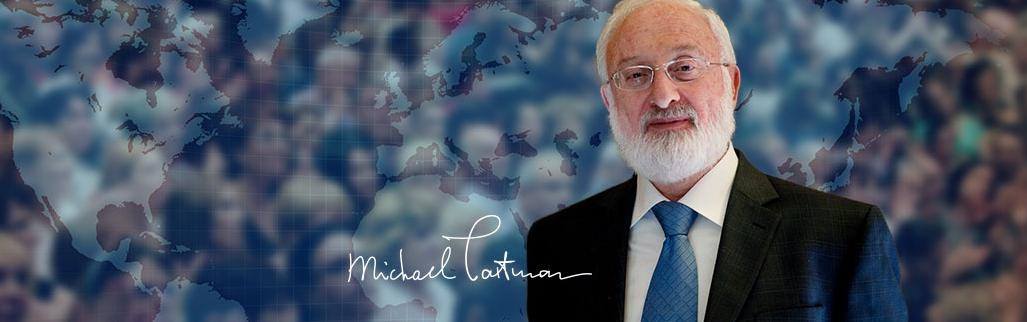 From My Facebook Page Michael Laitman 5/5/22




 Michael Laitman, On Quora: